While I was at
Autodesk’s office in
San Francisco, I was fortunate enough to have been given a tour of many of
Autodesk’s Labs projects. John Schmier,
Autodesk Labs Engineer and Evangelist, was very happy to show off several of the Labs Projects. In this tour there were many examples of 3D printing. The ability to send a file to a 3D printer right out of AutoCAD was added to
AutoCAD 2010. It processes and sends your model to a 3D printing service. You will receive your model in the mail after a few days time! With the cost of 3D printers around $30,000 apiece (that price various greatly depending on what it does, etc.), it can very difficult for firms to have this ability in house.
Here are some photos of what Autodesk had on display.


If you went to Autodesk University 2008 you will probably recognize the motorcycle in the photos. Every part was created via 3D printing technology.

Many of you might recognize the Touch Screen from AU. It is a giant screen that has touch interface. Depending on which program you are running, you can use a certain amount of touch points to manipulate your files. This display had touch enabled version of Autodesk Design Review and Autodesk Mudbox. Using different combinations of touch points and movement you can navigate through a DWG file or you could render a 3D object in Mudbox. Autodesk is studying ways humans can interface with computers. The software is there, but making it so it can run on different hardware is evidently the issue.
Windows 7 is supposed to support touch technology, so we should be seeing more and more hardware and software available with touch interface technology. HP also has hardware out that can handle up to four touch points, but Autodesk’s software has been developed to work with eight to ten. The software and the hardware are still in need of coming together before this technology type becomes more mainstream.
One of the other pieces of technology highlighted in my tour featured other ways of interfacing with the computer. Autodesk is looking for more ways to take everyday hardware that is relatively inexpensive and apply it to new ways for humans to interface with computers. In this example, Autodesk took a remote control from a Nintendo Wii (
download the driver here) and was navigating through a Design Review file. Another device was nothing more than a cardboard cube. A basic web cam was looking at the device and could recognize which side was up! It was using a form of
Augmented Reality. To turn the drawing object on the computer screen so that the back was displayed, rotate the cube in your hand until the back was showing. It works just like the View Cube in AutoCAD and Design Review, but it is a physical object that a person can hold in his or her hands. It can make presenting a drawing more simple for those that are not as familiar with the display controls inside Autodesk products.
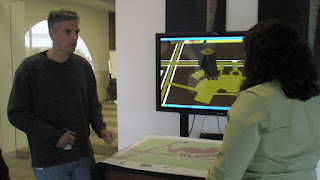
Using a simple web cam, the Labs had a display that can easily be applied to spatial planning. This was also using
Augmented Reality (click the link to see a YouTube video of this tech being demonstrated.) There was a computer, large screen and a web cam that was viewing a flat display on a table in front of the screen. The display was flat and had tiles on it. Each tile had a picture of a building, parking layout, or other equipment or buildings. The tiles on the display mat were read by the web cam and recognized to represent 3D models on the screen. The software running could then analyze the data shown and conduct process like light studies or airflow around the buildings. This tool is meant to aid spatial planners of all sorts to be able to look at objects and see how they interact with each other. City Planners and warehouse designers could quickly throw down some tiles and see where they can fit, how they affect the surrounding area, and more.
The last bit of technology shown that I want to talk about was the Boom Chameleon. The Labs department has been displaying this bit of tech for some time now and I was glad to get a chance to see it in person. There are many different applications that can take advantage of this device. The Boom Chameleon demonstrates how car manufacturers can save millions of dollars working on prototypes for new car designs. The Boom on display takes a 3D model of a car (in this case, but it could be anything) and allows the user to walk around it, inspecting it in real time and size. The device consists of a platform with a tower and boom. There is a screen at the end of the boom that can be lifted, lowered, and spun to simulate a person looking at a real car. Where you move the boom and screen will determine where you are looking. It replicates a physical car. Evidently it take about a million dollars for a car company to create a full scale model of a new car. With the technology of the Boom Chameleon, they no longer have to create as many real models. They can conduct inspections of the new design and get a good feel of how the car will look before it exists. It is estimated that this technology could reduce the amount of models created by 50%.
This technology can also be applied to building inspections and constructions. Using the Chameleon and BIM, users can take the boom out to an existing building, move it around a room and "see" what is inside the walls, floor and ceiling before they start punching holes and destroying whats inside. Very useful, as long as the data is correct!
There was a lot of exciting technology on display by Autodesk Labs at the San Francisco office and I greatly appreciated John’s tour. If you havent, visit
Autodesk Labs and
Scott Sheppards Blog. You may be surprised by what they have available. Oh, and here is a
link from Scotts blog about the event I attended.
Happy CADDING.
 So, in my time as a blogger I have written about some pretty interesting things. I have also written about some pretty strange things and even some downright absurd things. However, this story may just be in a league of its own.


